Imagine being told that a venerated nutritional staple—a food source cherished in your family lineage going back thousands of years—might not be safe to eat.
As Chronic Wasting Disease reaches more members of the wild deer family and as its presence expands to more U.S. states and Canadian provinces, the deepest level of concern exists among hunters putting game meat on the table. Could fatal CWD, a prion-vectored cousin of Mad Cow, one day jump the species barrier and infect humans?
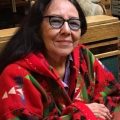
Lois Red Elk reminds that Indian Country is well aware of the progression of CWD and many discussions are taking place around kitchen tables. Recently, deer carcasses in Montana tested positive for CWD not far from her community of Fort Peck in the northeast corner of the state.
“I have been so sad about the Chronic Wasting Disease that is plaguing deer. Deer are a real staple to so many of our tribal people during the winter,” she writes, offering two poems that speak to the relationship with deer that the Dakota and Lakota have.

“Deer—Tahca—have an important cultural role in our lives,” she explains. ” We have legends for deer, how to approach a deer, how to butcher a deer, all the uses of the deer bones and joints, what is important for women to learn from the processing and distribution of deer, how to tan deer hides, and how to pay respect to this important animal by not wasting any part of it.”
Inspiration for Red Elk’s first poem, Game, comes from wisdom handed down from her father based on an experience his family had while hunting. “He explained it in Lakota and it was very poetic to me so I translated it into poetry,” she says.
The second poem is titled The Knife Wearer. “It recalls the experience all Dakota/Lakota women have to participate in in order to wear a knife,” she says. “The knife is not just an ornament that looks pretty or interesting to wear. The ownership of a knife sheath and knife have to be earned. To see deer and other animals suffering from such a harmful disease as Chronic Wasting hurts my heart as a relative and a friend to the deer.” —Mountain Journal Editors.

Game
By Lois Red Elk
Tracks are all that define these voices,
hungry lives pulsing sacred ground.
We are a journey of distressed shapes,
red essence on parchment, occupying a life.
We look for the fated four-legged that paced
this way, a tested and well-worn path
among storms, mud, into this shared hidden
brush. Coyote, slipping by through old
winter grass, warns in a pagan tongue,
licking after our scent. We pickup pace,
tighten our careless reins, snap back at the
yellow eyed clown with throat hunger,
that gnawing bone that drives us on. Quieted
we hear the heart beating. A desperate breath,
crashes through dry branches, a silhouette
give away. In an instant we let go
of weapons and invite a quick death. We
watch our knives glistening. Obsidian
works for us. What image of blood on flesh,
odor of iron. A vermillion sun heavy with
spring, looks upon reflections of death
in hard visions, our favorable hunt –
whitetail not quick enough for down-wind
lessons. Our horses burdened, deer shadows
left on landscape, we push forward.
These tracks ours now. Game will heal all.
Our offspring dance, grandmother prepares a
fire and sharpens another knife. During the
feast we thank any God absent from our table.
©Lois Red Elk

The Knife Wearer
By Lois Red Elk
This morning we found ourselves skinning a deer,
cutting meat, hanging some to dry and packaging
some for the freezer. It was the dogs late last night
that set off a howling, the unexpected smell of fresh
blood floating down the block, then a familiar car
horn honking in the driveway. My nephew and his
friends were hunting and brought us a deer. Mother
always said, “Cut-up the meat right away, don’t let
it sit.” I look at a front quarter, a hole filled with
coagulated blood. Grandma says not to eat the part
next to the wound, “cut it out; offer it to the earth for
healing, a sacrifice to remember the hungering spirits”.
Auntie says to save the muscle along the back strap,
“It makes good thread”. I carefully learned the exact
place to cut the joints so the bones separate easily.
Mother said that is important – “it means you are a
thoughtful person”. Auntie is at the door waiting for
a roast. “An elder takes the first piece, she reminded.”
Mom tells me to save the hooves for her. She wants
to make a bone game for the new grandchild, wants
them to be patient and skillful. I boil the hoofs with
sage, find the little toe-bones for her. My hands begin
to ache from all the work, I soak them in warm water
and start again. I admire the placement of tendons
on the deer shoulders, no joints, just the crisscrossing
of muscle. Grandma says, that’s why your dad called
them jumpers, they bounce off the strength of their
flexing muscles. Late at night mom helps me stake
out the hide. My back hurts; my feet feel like I’ve
been walking on rocks all day. I want to complain,
but mom caught the look in my eyes. She said to me,
“When you get dressed for the dance this weekend,
you will proudly wear your beautiful beaded dress,
your beaded leggings and moccasins, and last but not
least, you will put on your beaded belt, and attached
you will wear your sharp knife and quilled knife sheath
because of what you have done this day”.
©Lois Red Elk
EDITOR’S NOTE: For these and other poems by Lois Red Elk, check out her volume Dragonfly Weather.