An apparent mistake that led at least 3,000 Gallatin County taxpayers to collectively overpay more than $8.5 million in property taxes over four years has carried impacts to budgets and has left county officials scrambling to work out whether they can offer a refund.
The tax error, discovered and corrected in late September, will reduce the tax burden for Gallatin County property owners in the Big Sky Fire District while also slashing the budget of the Big Sky Fire Department by millions.
The Big Sky Fire District spans 80 square miles across both Gallatin and Madison counties and has around 3,250 full-time residents as of 2022. The fire department is mostly funded by county property taxes and the Big Sky resort tax, and has for years based its annual budgets on allocations now deemed incorrect.
While Madison County has been collecting its taxes correctly, Gallatin County learned in September that, for four years, it had been applying the voter-approved mill rate to its levy rather than capping the collected dollars in accordance with Montana law, said Gallatin County Administrator Jim Doar.
Montana’s levy system requires local governments to recalculate mill rates each year based on total taxable value and state inflation caps, rather than using rates previously approved by voters. Collecting amounts that exceeded the cap resulted in overcollections, and now Gallatin residents could see a reduction of up to 50 percent on their next fire department tax bill, officials said.
The mistake stemmed from using an incorrect formula on an Excel spreadsheet, according to Doar.
In late September, Gallatin County’s chief financial officer, Justine Swanson, resigned abruptly without explanation, though it’s unclear if the events are connected. Swanson did not respond to requests for comment for this story.
Impacts to Big Sky’s Fire Department
The situation reduced the fire department’s budget by 15 percent, leaving it with around $2.3 million less for this fiscal year compared to last.
Big Sky Fire Chief Dustin Tetrault said the department was already struggling to provide comprehensive services to the fast-growing, forested resort town that has a greater risk of seeing a wildfire than 93 percent of communities in America.
“Despite the over-taxation that was happening up here, we were still behind the development curve of the community,” he said. “Keeping up was already a challenge, and unfortunately this is going to set us back a few years in terms of meeting that demand.”
The department reduced the $2.3 million shortfall to around $500,000, according to Tetrault, by cancelling planned building upgrades and equipment purchases and using money in reserves.
“Something like this happens, and do you just pump the brakes and cease to move an organization forward, or do you continue to try to set the future leaders of their organization and future firefighters up for success?”
Dustin tetrault, chief, big sky fire department
The projects the district cut included plans to install water and sewer connections to the new firefighter training facility, where they have been relying on porta-potties; plans to replace cracked concrete surrounding Fire Station 2; and plans for purchasing a large commercial washing machine to clean uniforms exposed to potentially harmful chemicals.
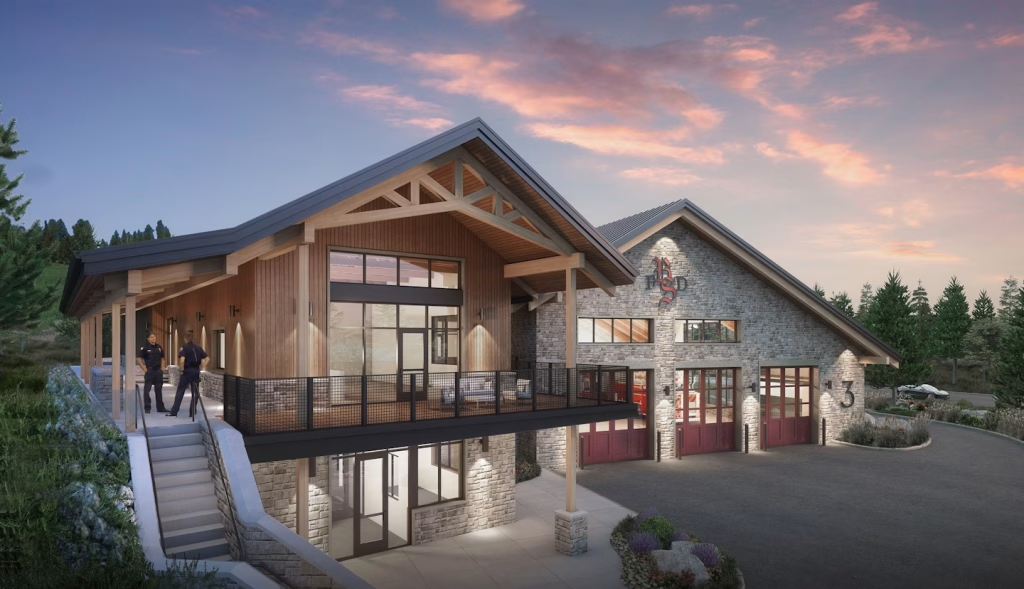
Plans were also tabled to hire four new full-time employees to staff the forthcoming Fire Station 3 in Spanish Peaks. Tetrault said construction wasn’t halted on the $19 million station because it was already fully funded by a rural improvement district tax approved by residents. But there is now no money available to staff the station, which is expected to open in January 2027.
Currently, the fire district has 42 full-time employees and nine seasonal staff members who comprise the wildland crew. Asked if they would be forced to cut personnel, Tetrault said, “Not right now.”
The fire district also withdrew from committing $50,000 over the next two years to help fund a forest stewardship position housed under the nonprofit Grow Wild, which could have helped the Big Sky community better prepare for wildfire impacts.
The proposed area forester would provide site visits for Big Sky homeowners seeking to create defensible space on their property. A trained forester can also give tailored advice about tree thinning and invasive species management. It would take that load off the fire department, which currently advises homeowners on these matters, said Jen Mohler, Grow Wild’s executive director.
At the Big Sky Resort Tax District meeting on October 21, Mohler addressed the fire department’s withdrawal of financial support, which means filling the position will not move forward this year. The resort tax board did however vote to allocate a conditional $20,500 for the position if Grow Wild can fundraise $50,000 of their own money.
Sarah Blechta, chair of the Resort Tax Board, said it’s critical for homeowners to mitigate wildfire risk on their property. Big Sky sits squarely in the wildland-urban interface, and many residents have seen exorbitant home insurance rates or outright policy cancellations due to the high fire risk, she said, adding that building defensible space can help decrease that risk for the whole community.
Of the tax error, Blechta said the situation is “a bummer for everyone involved.” She added that the fire department is in its second year of a three-year allocation from the resort tax.
According to Tetrault, the department needs a long-term solution to shore up additional funding, which could involve tapping the resort tax or seeking voter approval. It’s frustrating, he says, because the department has worked hard to be fiscally responsible to avoid asking taxpayers for more money, while also trying to grow with the community.
“I think that’s the hardest thing,” Tetrault said. “Something like this happens, and do you just pump the brakes and cease to move an organization forward, or do you continue to try to set the future leaders of their organization and future firefighters up for success?”
Tetrault is unclear why no one noticed the mistake for four years. He said his best guess is that the complexity of Montana’s tax system, which routinely changes with new legislation, means only a few people genuinely understand it well enough to spot errors. Tetrault also noted that the system lacks checks and balances. The Montana Department of Revenue “just essentially looks at it and signs off,” he said of the work of county chief financial officers.
Gallatin County officials under scrutiny
Gallatin County’s Doar said many people, including the Big Sky Fire District board, are now asking how often the county is audited and how an auditor did not catch the mistake.
The county receives an external audit each year, which has in recent years been completed by the accounting firm Eide Bailly, Doar said. But auditors don’t typically look at granular details such as Excel spreadsheet formulas, he said. Rather, they are checking to see if invoices match expenses and if money is being allocated appropriately.
He added that the county investigated and did not find the same error in other property tax collections. Unrelated to the error, Doar said the county was in the middle of transitioning accounting databases from Excel to a software called Gravity, which he said should reduce the likelihood of future errors.
Doar said he does not know the reason for Swanson’s departure. He said he received an email from her saying she was resigning effective immediately, and the timing of it coinciding with the error revelation was “really unfortunate.”
Last week, the Bozeman Daily Chronicle reported that county commissioner Jennifer Boyer said the reason for Swanson’s departure was related to “a mistake” but did not elaborate further. Doar said he was not a part of that conversation and does not know what Boyer was referring to.
“I know people are speculating and leveling accusations without knowing the facts, and that is really unfair to someone like Justine,” Doar said. “There is zero evidence of any fraud in Gallatin County.”
Asked about the possibility of refunding taxpayers, Doar said it would be “very, very, very unlikely.”
Complications would arise, he said, from trying to sort out how property ownership has changed over the potential refund period, especially in an area like Big Sky where housing sales are common. It would be difficult to determine who specifically is owed what and the years they lived there, Doar said. The $8.5 million overcharge figure was calculated based on the tax formula discrepancies, not by totaling up the amount individuals paid, he said.
Doar also said it’s unclear if refund money would come from the fire department or the county.
“Nobody knows that because it’s never been contemplated in law,” he said. “There is no clear process.”
Sean Morrison, a tax attorney in Helena, shared insight on the legal landscape but emphasized that he’s not providing legal advice.
In general, it is incumbent on the individual taxpayer to file a refund claim, Morrison said. But how a taxpayer files a refund claim depends on whether the error is related to the assessment or the collection of the tax. If the error is related to the collection, Montana Code Annotated 15-16-603 generally gives individuals 10 years to submit a written claim to county commissioners disputing the amount. If the error is related to the assessment, a taxpayer must follow the procedures for an appeal with the Department of Revenue.
In some unique cases, taxpayers have successfully recovered damages as part of a class action lawsuit, Morrison said. But that situation may not apply here, especially if taxpayers still have time to make a refund claim with the county or revenue department.
Morrison said in general that an Excel spreadsheet error is “pretty in the weeds” for auditors to catch.
Tetrault said he understands the frustration of people who were over-taxed. If the fire department was tapped to refund people, they would figure out a way to move forward.
“We would make it work because it’s the right thing to do. But it would drastically impact our service delivery,” Tetrault said. “I think the big thing for folks to think about is yes, it was a mistake and it was wrong they paid more, but the money came back to the fire district, which we then put into community programs, to salary increases for our staff so they could live in Gallatin County, all these different things. It wasn’t like the money went to no good.”