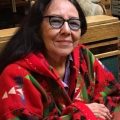
by Lois Red Elk
Hello friends of Mountain Journal,
I took a break from everything and am just returning from camping with all my Dakota/Lakota relatives on the beautiful homelands of the Dakotas.
It was the time of year for our very sacred ceremony that occurs during the Moon when chokecherries turn black. It is our thanks giving ceremony when all the seven bands of the Dakota/Lakota
gather.
My home was a tipi for a full week. Every morning I was awakened by a camp crier, calling us to greet the sun and pray. My neighbor would start a wood fire and put on a pot of coffee. The smell of
wood smoke and brewing coffee was like a home I knew as a child. Everyday our camp circle took turns cooking and preparing all the sacred medicines we would need for the day.
I met up with friends I haven’t seen for years, made so many new ones and was energized by all the young people who requested storytelling.

I watched as the sacred tree was brought into the camp and witnessed all the young adults who pledged to dance, learn the sacred songs of ceremony and bring unity and peace to our people. All the activity of the camp brought back memories of times I witnessed as a youth and thought I wouldn’t see again. Especially did I remember one morning, getting up very early, to pray with my grandmother.
In all the times of listening to her prayers, she always referred to the earth as a relative. This one morning she addressed the sun as a relative, one that arrives faithfully, one that is greeted as a special
guest, and one that should be treated as the revered one. I’m offering two poems this month. And, I’m sure you all know what the ceremony Is called.

The Sun is Coming
Standing with grandma in the early
hours, I am little but a part of this new
day, breeze is brushing my cheeks, chin,
tossing my hair, I feel her body close,
watch as she unfolds hands filled with
tobacco and know it is a sign for prayer,
good words. She sings with the rays of
light springing from Maka Unci, keeps
tempo with each bowing stem of grass,
their motion created from surges of the
ground wind. She is thankful for this
moment, her time to remember all that
will come today. She prays especially
for the Sun Dancers, her nephews, all
the uncles who will know the height,
the heat of the sun. We watch as birds
arrive, begin their songs. She turns
around and lifts her hand and I watch
the tobacco float away. She tells me we
will honor a special guest, one who takes
care of us every day, one who never lets
us down. Again she says, we will be busy
today asks me to bow my head, “Say
thank you to the Sun.” I do, and always
I’ll remember how she took my hands,
smiled down at me, then turned again to
look at the breaking light. “Wayanka
takoja” she said. “Look granddaughter,
the Sun is coming, we have to get ready,”
©Lois Red Elk
Maka Unci – Grandmother Earth

Somewhere Between
(for nephew Russ)
Somewhere between faith and
his cluster of
commitments, a common man
inhales love for
his people as he begins his flesh
sacrifice at the
sacred Sun Dance pole. He gulps
moisture from
humid air and lifts his prayers to a
southern wind asking
his dragonfly to use its speed and
take him quickly
to the world where vision is caught
in hope, where
sacrifice is recognized and his
weakness turns into
a victory over all that is negative.
The tethered ropes
hold firm jagged pieces
of his body,
his crying heart, and solemn words
for the 2-legged,
the children of mother earth. “This
dance is a thank
you for all that has been received,
and it is
a prayer that the people will continue.”
©Lois Red Elk
EDITOR’S NOTE: Ms. Red Elk is working on a new volume of poems. She is author of several collections of poems. Ask for them at your favorite local bookseller.