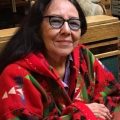
Lois Red Elk’s ancestral lines in North America stretch back, well, who knows exactly how far? When the ancient Egyptians were building the pyramids at Giza 4,500 years ago, her people had already been here 8,000 years or longer. How does that tenure compare to a Westerner who claims one’s affinity for the land runs deep and profound at four or five generations?
Red Elk today is writing as a woman elder who has given a lot of thought to newcomers entering a land not native to them. “My heart has been so sad for the so-called immigrant children who have been separated from their mothers, fathers and families,” she writes in sending Mountain Journal a fresh batch of poems. “I prayed a full day last week for their spiritual and mental wellbeing. I also thought about our mutual cultural beliefs about the sacredness of children.”

How are the doors of a new life opened and closed to the most vulnerable seeking shelter and comfort, she wonders. “In indigenous knowledge we have encoded into our languages how our senses respond to new and different situations,” she says. “There is always a connection to spirit in all our senses that provide us with resilience. One of those words is Ableza which in the Lakota language means “to realize.”
On that note, absorb the following two poems from the Montana poet; the piece, Ableza, is new while Wakanyeja/Sacred Gift comes from her acclaimed volume Our Blood Remembers. Side by side, it appears in two languages yet the feeling it imbues is one every mother has known since human time began. —MoJo editors

By Lois Red Elk
Ableze—for all our brown children: An Introduction
I always imagined the moment when my first child would speak their
first word, even before I had a child. This thought came during a quiet
time while on my moon. It was one of the hundreds of curious thoughts
I remembered for future times. This was not made up by me. It is a belief
observed by Lakota culture. The first word uttered by a Wakanyeja, or a
little child, brings life to their being, when they become perceiving humans,
when they can express, in voice, a connection in their mind between sight,
talk, hearing and knowing
Ableze
Imagine a spirit leaving the cosmo, the stars,
earth bound, to live as a human being. They
enter the atmosphere like a blazing meteorite,
like a falling star. They come in the shape of
a spiritual seed, the essence of sperm and egg
full of all the information they will need to bud
grow, bloom, develop, exist, similar to a plant,
flower or a tree. Imagine this seed now uses
all its instructions to see, feel, touch, hear and
then to speak. Imagine the voice, vocal cords
vibrating, breath inhaling, then they discover
they can make sounds. Imagine they hear all
the songs from the longhouse, the songs of the
Sundance, hear the songs of the Nahuatl sunrise,
the songs of Aztec ball games, they hear songs
of spirit, family, play and life and they know all
the words and meanings, know all the pitches
and notes. Imagine they learn all the prayers,
all the speech’s and rites. They come to this
time with encouragement, with love and help,
they have listened and watched all those who
speak. Imagine they stop and wonder how
they first started to speak, when they realized
they had a voice, what was their first word?
Ceremony marks the time when perceiving
comes to babies. We remember the child’s
first word, when they realize that moments
have purpose, when life gives them meaning.
©Lois Red Elk

By Lois Red Elk
Wakanyeja Sacred Being (a child)
for Isanti for Isanti
Apetu ki This day
wicin cana wan ici mani a female traveler has arrived
kimiminawa a butterfly
omaki yaka said to me
Apetu ki This day
wana hi she has arrived
Mitakana My little sister
wanayaka behold
Apetu ki This day
wicin cana wan ici mani a female traveler has arrived
Wakanyeja A sacred gift
wana hi has arrived
Mitakuyapi My relative
wanayaka behold
Wakanyeja A sacred gift
wana hi has arrived
A female traveler has arrived means a baby girl has been born.
This poem was written on the arrival of my youngest granddaughter.
©Lois Red Elk
A female traveler has arrived means a baby girl has been born.
This poem was written on the arrival of my youngest granddaughter.
©Lois Red Elk